Q&A with Skan AI's Avinash Misra and Manish Garg
.png)
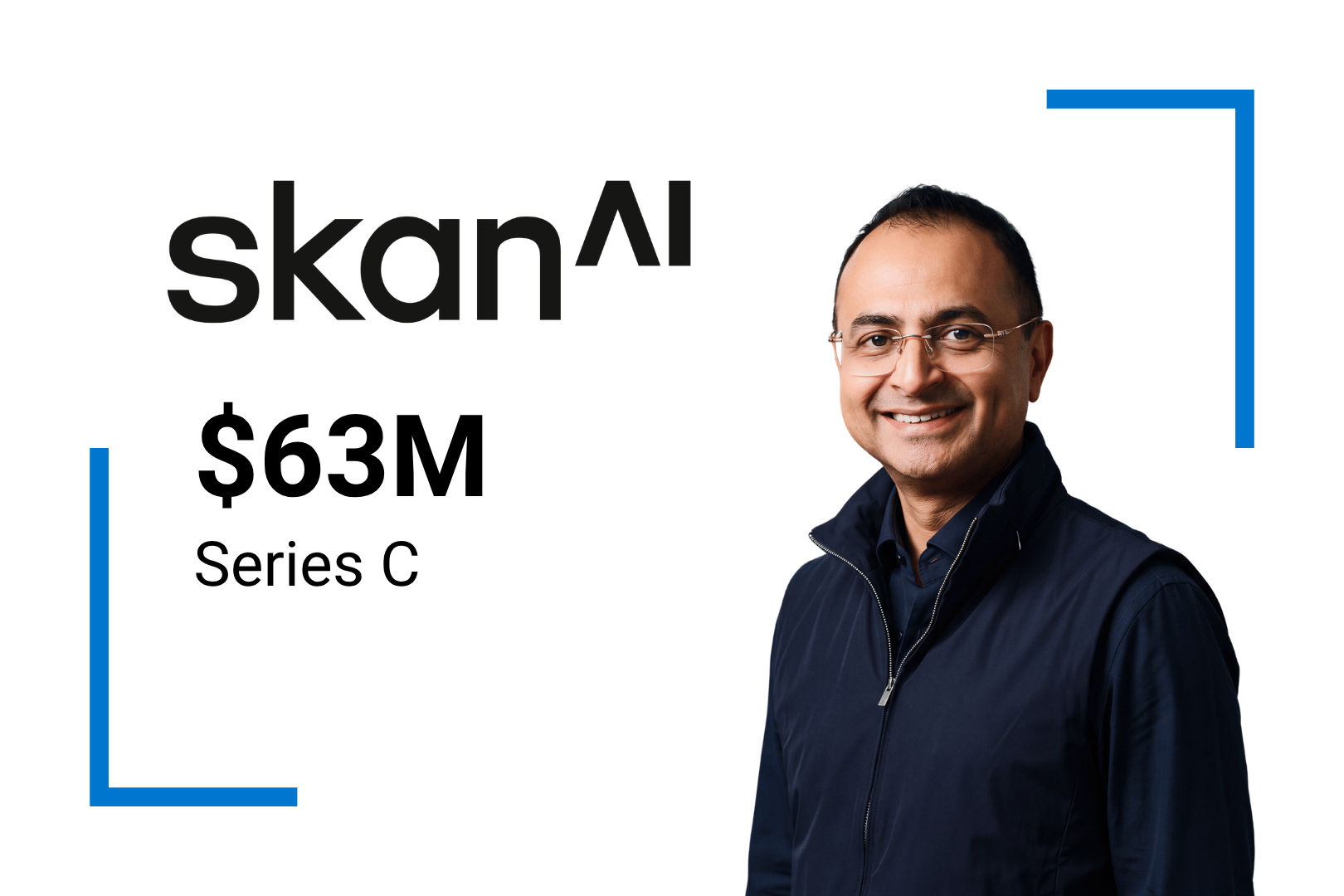
Skan AI's co-founders CPTO Manish Garg (l) and CEO Avinash Misra (r).
DTC led Skan's Series B and co-led their Series C because we believe the company is solving one of the most important barriers to enterprise AI adoption: creating a machine-readable understanding of the context of real-world work.
As enterprises race to adopt AI, many are discovering that deploying agents is the easy part. The harder challenge is giving those agents a complete understanding or context of how work actually gets done inside the business.
This is a challenge that the team at Skan AI is addressing. So we grabbed some time with founders Avinash Misra and Manish Garg to dive into how the enterprise is adopting AI, why context matters so much, and what they've learned from the billions of work signals they've processed so far. Read on.
In 2022, you talked about the opacity of work being the reason digital transformation fails. How has AI changed that challenge?
Avinash: Well first, it validated our thesis, that if you don't understand how the business is actually running, you won't be able to transform it. That has become 10 or 100 times more true when companies try to use AI agents to automate processes inside the business. We've seen organizations investing huge amounts in AI projects, only to see them fail because the underlying work was opaque to those agents. They simply did not understand how it was being done, so there was no way to replicate the work correctly.
Enterprises are under pressure to have an AI strategy/story. What are you seeing them get wrong when they deploy agents into real business processes? And what are some of them getting right?
Manish: People knock on our door after they have tried to deploy agents without being able to feed those agents a full, structured understanding of the work that those agents are taking on. We call that structured understanding "the Context Graph of Work." They thought the hard part was spinning up the agents. The difficult part, the part that Skan has spent years solving, is how to capture every part of how processes are done and then structuring that in a way that can make the agents succeed.
When you first meet a Fortune 500 prospective customer, who is typically feeling the most pressure to adopt AI? The CIO? COO? Business unit leader? Someone else?
Avinash: Yes. (Laughs.) The pressure comes from every direction. Wall Street wants to know how you're embracing AI. The Board wants to know that they can tell Wall Street that they are embracing AI. The CIO hears stories from other CIOs about the amazing things they're supposedly doing in their organization. And on and on. The pressure is real. But that pressure to show results quickly led to organizations undertaking AI projects without understanding what is required to make them successful.
Are buyers coming to you with a clear use case, or are they coming with a mandate to "do AI" and asking you to help figure out where to start? Has that changed over the last year or two?
Avinash: We often hear from large organizations after they struggled to take a pilot project and scale it. They come to understand that giving AI models a list of Standard Operating Procedures and job manuals is a recipe for failure. They come to us because they now understand that they need a full picture of how work is being done, and they're not able to produce that on their own. One of our products, called Blueprint, helps establish an enterprise AI transformation roadmap: what to automate, what to improve first, what to eliminate, where humans remain critical, and where AI can create measurable value.
Can you describe a customer journey from problem identification to measurable ROI?
Avinash: Of course. Customers can start with us in different places, depending on the problem they're trying to solve.
Some start by asking where AI can create the most value. Using Blueprint, we observe how work, skills, and systems actually connect, and come back with a ranked map of where AI creates real value, what should be eliminated outright, and, just as importantly, where a human needs to stay in the loop. That answers the question every CEO actually has: where in my business does AI even matter? What does my multi-year AI roadmap look like? How do we justify the investment?
Other customers already know the specific process they want to improve. With one of our insurance clients, for example, we observed thousands of live claims, and where the business assumed there was one standardized process, we found more than 350 different ways adjusters were actually handling it. For the first time, the business could see the gap between what they thought was happening and what was actually happening. We then rank those gaps by dollar impact and help them improve and standardize the highest-value paths, because there's no point automating a process nobody agrees on yet.
And increasingly, customers can start directly with agentification. In that case, we observe the work specifically with the agent in mind, building the context around how decisions get made, which systems and data are involved, what exceptions occur, and where humans need to stay in the loop. That context is what allows agents to operate reliably in the real world.
So I don't think of this as three sequential phases customers have to march through in order. They're three interconnected ways to engage with Skan, understand where the opportunity is, improve how work gets done, or agentify it directly, and customers can start anywhere.
The common thread, wherever you start, is measurement. We set a baseline before anything changes, and once agents or process changes go live, we continuously measure the actual operating state against that baseline, not a one-time before-and-after, but an ongoing check that the transformation is delivering the outcome we said it would. That's how "measurable ROI" stays measurable: lower cost, greater throughput, better quality, and a number you can keep pointing back to, not just a number you got to claim once at launch.
You've processed literally billions of work signals. Are there patterns you see repeatedly across enterprises regardless of industry?
Manish: From Skan's vantage point, the patterns are remarkably consistent whether you're looking at an insurance claims operation, a bank's KYC process, or a health system's prior-authorization team.
The first is the invisible-work problem. A surprising amount of execution happens outside the process map and often between the systems of record, people copying information across applications, reconciling conflicting data, checking spreadsheets, interpreting emails, or creating workarounds just to keep the process moving. The system records the transaction; it rarely records the work required to make that transaction happen.
Second, we consistently see extreme process variance and concentrated expertise. What management believes is one process may actually be hundreds of execution paths, with a relatively small number of experienced people knowing which path to take when something unusual happens. That tribal knowledge is effectively part of the company's operating system, but it has never been encoded anywhere.
And third, the best opportunities for agents are often counterintuitive. The most repetitive task isn't necessarily the best one to automate. What matters is whether the decisions, exceptions, dependencies, and human judgment surrounding that work can be understood and represented as context.
So after observing billions of work signals, one conclusion becomes very clear: enterprises don't have a shortage of AI capability. They have a shortage of machine-readable understanding of how their own work actually gets done. And that is the problem Skan is solving.
And, for your most successful customers, how are they positioning automation internally to increase adoption/success/ROI?
Avinash: The best version of this isn't AI replacing people, it's AI finally freeing people to do the work only they can do. A claims adjuster who used to spend half their day on routine exceptions gets to focus on the cases that actually need their judgment. A new hire who used to take six months to reach full productivity gets there in weeks. And just as important, the expertise your most experienced people have built over a career doesn't have to disappear when they retire. They're positioning automation as a way to unleash people's expertise and allow them to spend their work time where they are uniquely qualified to offer value and get real meaning from their jobs.
Are there any processes that we're still pretty far away from automating?
Manish: Absolutely, but I think the better question isn't which processes can be automated. It's which decisions should be delegated to a machine, and which should stay human.
Take claims adjusting, an area where we do a lot of work. Agents can increasingly gather evidence, reconcile information across systems, identify inconsistencies, and handle routine decisions. But when there's an unusual loss, conflicting evidence, potential fraud, or a decision that requires judgment and empathy, that's where human expertise becomes more valuable, not less.
The distinction that matters here isn't "not automatable" versus "automatable." It's "shouldn't be fully automated." The technology often could eventually handle more of these decisions, the real issue is that some decisions carry high ambiguity, real risk, or regulatory weight, and the winning architecture is human plus agent, not human or agent.
So the opportunity is to automate everything surrounding that moment of judgment, so experts spend dramatically more of their time actually being experts, not less of it.
That means deliberately engineering the boundary between human and machine: what an agent can do autonomously, when it should escalate, what context the human needs at that moment, and how the agent learns from that intervention. This is one of the things many organizations, and many technology companies, get wrong about introducing agents into a business, success depends on getting your people to embrace working alongside agents, not fearing being replaced by them. That takes real empathy for your teams and genuine understanding of how this shift affects them.
Successful agentification isn't about removing humans from a process. It's about designing a fundamentally better way for humans and machines to work together.
Thanks to Avinash and Manish for taking the time for the DTC interview. To learn more about their work, visit Skan.ai. And, checkout our 2022 interview with Avinash on founding the company, his leadership style, and the many, many books he's read.

.png)
.png)