Supply Chain and Logistics: At an AI Inflection Point
Ahead of Manifest, we talked to CEOs of Augment, G2 Reverse Logistics, Pecan, and Tag-N-Trac to get their outlook for the logistics and supply chain industries in 2026, as well as understand the near-term challenges to realizing AI’s potential.
Across the supply chain and freight industries, economic pressures, increased regulatory demands, and fluctuating rates are weighing on profits and complicating already deeply complex global operations.
Supply chain and logistics executives looking to understand how burgeoning AI solutions can mitigate these challenges. But from enterprise and third-party logistics providers to forwarders and brokers, companies in the space are already being bombarded with pitches about how AI can solve every problem they have. Interest in AI’s transformative potential is high but some skepticism is riding along with it.
“We have to earn their trust,” said G2 Reverse Logistics CEO Tom Perry “It's still a big leap.”
As thousands of industry executives descend on Las Vegas this week for the annual Manifest conference, AI is poised to be the main topic of discussion. But technology buyers are over the hype. They need to concretely see how AI can be applied in their real-world scenarios.
“AI has gone mainstream, and supply chain and logistics are no exception. People see a lot of opportunities to improve business processes, cost savings,” said Tag-n-Trac CEO Raj Dodhiawala. But now, they “also need to see some compelling value.”
Minimize the mundane
Despite being an incredibly complex industry, much of the day-to-day in supply chain and logistics is still manually driven. If not on paper, then by phone, email and data entry. The crucial but tedious work keeps people combing through inboxes and chasing down information. Because of this, historically, the industry has often operated in reactive mode.
Similar to what’s happening across every other industry, AI promises to deliver control over daily workloads, inboxes and manifests giving logistics professionals more agency, the ability to get ahead of potential problems, and to actually log off after hours.
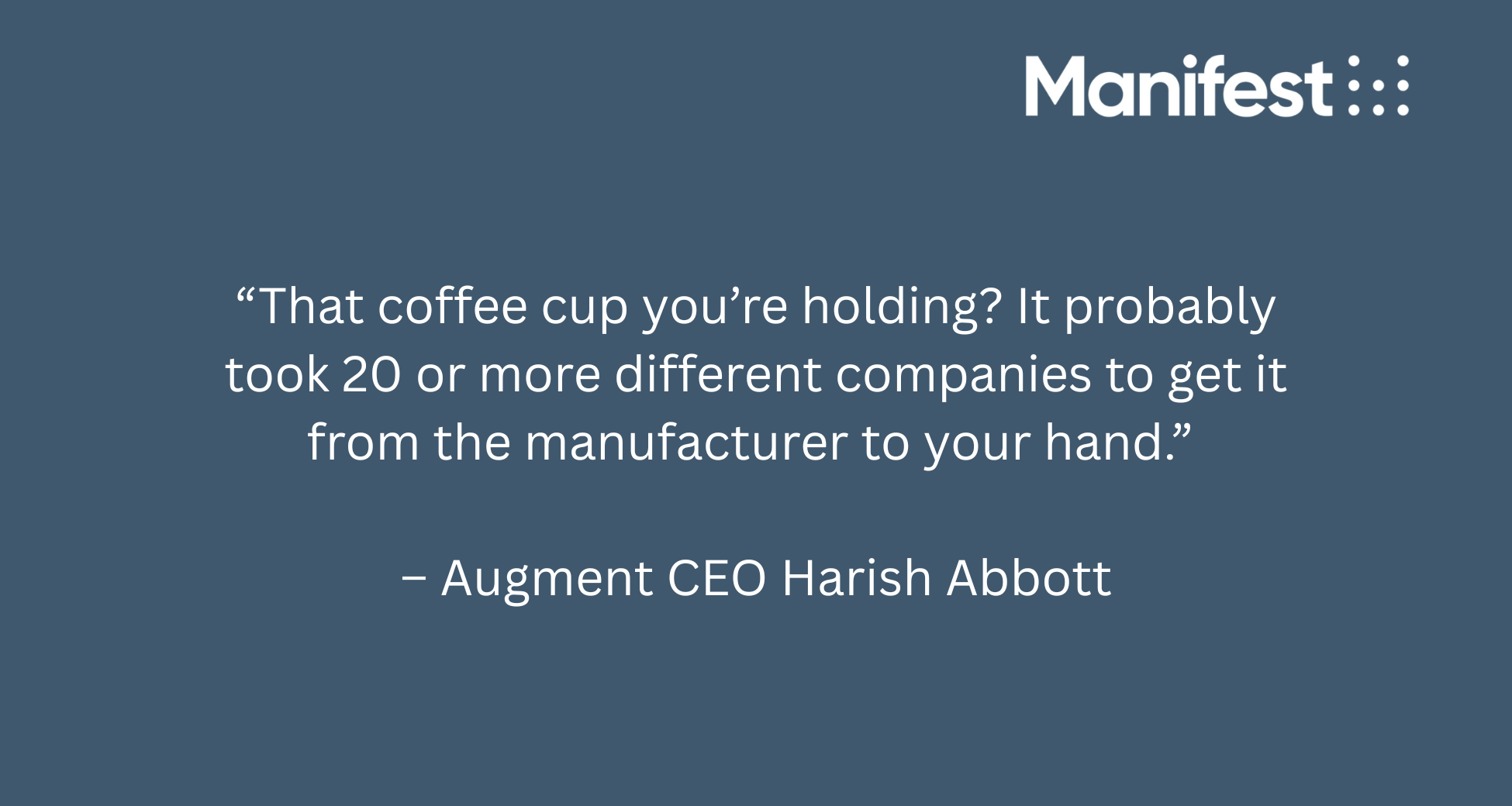
“We’re moving from making humans slightly more productive to taking work off their plate — and that's a profound change,” said Augment CEO Harish Abbott. “We’re going to use human potential to its highest degree possible.”
With the mundane handled, AI and humans can work together to solve multivariate, open-ended challenges. With AI in the mix, “there’s a greater chance for creativity,” said Tom Perry. At G2RL, Tom and team are focused on optimizing asset lifecycles on the reverse logistics end: dispositioning returns.
Today, returning or end-of-life electronics might have a few streams available: refurb, recycle, or landfill. With G2RL, there could be dozens of streams to choose from at the component level of a returning item. That way “you get to optimize for which ones make the most sense to pursue, are you trying to save the planet? Are you trying to make money? With AI, can you do both?” asked Tom. That’s where things get interesting.
The opportunity in the discrete
Supply chain leaders know there’s much to be gained from AI implementation. But they’re most interested in relatively low-risk ways to experiment while still getting to positive return on investment. They’re looking to start small – or with the “low hanging fruit” common and repeatable use cases.
For example, it’s not that uncommon for air cargo shipments to not make their scheduled plane or for split loads to not make it on the right truck at transfer. These displaced shipments can take hours, sometimes days to find. So why not slap a physical sensor on the shipment that ties into a platform that can combine location, flight information, weather delays, and bay availability together that can provide a real time journey view and also anticipate disruptions further along the chain?
With supply chain disruptions, “there is no best practice there,” said Raj. “These are failures that are ripe for bringing some discipline, some automation and AI to reduce the human workload.”
While it may seem like leaving opportunity on the table with improving just one aspect of the full logistics motion at a time, the upside is often amplified. Classic forms of AI like predictive analytics can “improve forecast accuracy that can have a compounding effect across the entire operation: inventory levels, service levels, labor planning, and automation all benefit,” said Harish.
And according to the CEOs, this is exactly what the buyers are looking for right now – narrow, defined-risk use cases that deliver tangible ROI.
Turning AI pilot to ROI/Profit
For any of the solutions from Augment, G2RL, Pecan, and Tag-n-Trac to succeed, they need access to the right systems, data, and context.
“While generic LLMs and foundational models provide insights based on publicly available non-structured data, they struggle with capturing the specific business nuances and complexities that usually reside in the proprietary tabular data,” said Pecan AI CEO Zohar Bronfman. “For AI to truly work, it needs context.”
That context is stored in systems of record and communications, and unifying this information is a key challenge to AI success. And given the complexity of global logistics, collecting the necessary third-party data is also critical. In fact, shipping a simple t-shirt can touch as many as 20 different companies, and even more underlying applications.
AI agents “need as much context as the human does,” said Harish. "Getting integrations done to get meaningful context is both a roadblock and an opportunity.”
Successful AI adoption is also about more than choosing the right technology and integrating the right data. Employees need to feel empowered to use the tools effectively. They need skill-specific training on how to best employ the various tools in their own work, as well as the freedom to experiment and rethink processes along the way.
“Beyond pilots, enterprises quickly realize that real AI value requires changes in ownership, incentives, and decision making processes. That realization often slows progress. The teams that move fastest are not the ones chasing the flashiest use cases, but those that demand a clear business case upfront and are willing to integrate AI into how work already gets done,” said Zohar.
Manifest 2026
While the theme of Manifest 2026 might be about measured steps to AI adoption, those in supply chain and logistics need to prepare for disruption: “The jobs and the people in your company are going to look materially different in a few years’ time. Adapting is a daunting task for everyone,” said Harish.
Fortunately, there are hundreds of startups that aim to help the enterprise and logistics industry capitalize with AI innovation. You can catch DTC-backed companies delivering on that promise at Manifest: Augment (booth 2113), Exotec (booth 965), Tag-n-Trac (booth 1546), Daybreak, G2RL, and Pecan.
.png)